

Unfortunately, there are no legends surrounding the birth of Evangelist Rayall. No eclipse blacked that ordinary afternoon's sun, no smoke machine sputtered, and there was not even a whisper of strange and mundane happenings nearby, like a nickel landing heads seventeen times in a row or a stained glass saint making an obscene gesture in a local chapel's window.
The little Louisville hospital in which Evangelist Rayall was delivered is made of sturdy rusticated brick, and has consistently failed to burn down and thus make myth of his first files. All relevant details are, in fact, known. He was born June 18th, 1918, without complications, as a standard issue boy of unimaginatively blended European lineage and a middle initial, V., that stood for nothing, to one mother, Eugenia Florence Rowan (nee Zolmuk), and one father, John Roebuck Rowan.
Again, no birds belted Latin liturgy, the cornerstones of Louisville's city hall did not shudder, and not a single backwater bootlegger repented his distilling. He was born, he soon learned to tell daylight from darkness, and these are the only essentials.
Life story
June 18, 1918
July 6, 1919
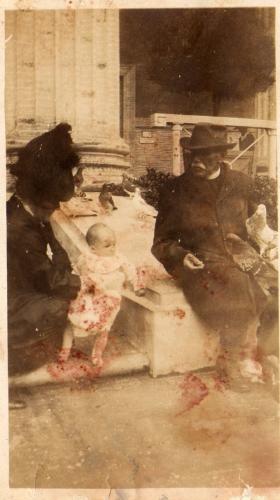 A criminally sunny day...
December 20, 2008
 "Always jump-start a story with the fact of the end," Evangelist Ray once told me. "If nothing dies, then there's no story." Of course, Evangelist Ray's tongue was rarely mistaken for solid silver, and it flickered behind no golden grills. Perhaps he was too often touched by Scotch to narrate well. But because Evangelist Ray's bequest for me was, in part, his impairment with narrative, let me begin at his preferred beginning.
 By the Roman calendar, Evangelist Rayall Rowan was wiped from sight on Dec. 19th, 2008. In his early twenties, the age in which dreamy sorts take tragic satisfaction in foreseeing their own youthful deaths, Evangelist Ray first drafted what would become, some seventy years on, the plot of his funeral service. It was as simple as the outline of a joyride.
___________________
In his 1921 film, The Phantom Carriage, Victor Sjostrom collaborates with a medieval Northern European folktale depicting the backroom politics of the transportation industry of newly departed souls. The tale revolves around Death's policy decision that the man who dies closest to New Year's Day must take up the reigns of a shadow paddy wagon that collects the souls of the deceased. The post lasts twelve months, and there is no chance for reassignment, promotion, or resignation.

Because Evangelist Rayall spent what would have been his college years in dingy cinemas, films took on for him the qualities of canonical texts. As he relates in his memoir, Evangelist Ray first saw The Phantom Carriage at a repertory cinema in Chicago in 1945, where it was preceded by a newsreel on the funeral of Franklin Roosevelt. Evangelist Ray writes, "Sjostrom's film was an exquisite foil for the brassy pomp and mechanized flag-flying of F.D.R.'s state funeral. An old drunken fool at the head of a rickety coach carting away souls--this was by far a truer image of the mundane and barely manageable business of death.
"To paraphrase Bohumil Hrabral, ''Young poets are obsessed with death, while the old ones can think of nothing but girls.' I was then a young poet and I had mortality on the mind. It's a vanity of an uncanny brand to dream up your own funeral, to make small talk among your mourners and arrange the bunches of flowers littering rented tabletops. And it's what I did, happily. I had a vision of the absurd spectacle of a sleek empty hearse loitering on city streets and followed by friends faded by drink. Of course, over the years that followed, that vision was gradually crowded out by all the intermediate business of a lengthy life. It wasn't until I was in my mid-sixties, newly sprung from a bid in an Orinda ICU, that it returned to me.

"It was the autumn of '85, amid the bay horses and Rolls Royces of the Oakland gangster Felix Mitchell's funeral procession, that I heard a foul echo of the blustery burial of that four-term monarch F.D.R. I began to preach on the subjects of Reaganomics and celebrity mortality, and I argued with that echo for a good hour before the overpresent police removed me as they might an unmoored madman. The coachman, an aged white fellow, sweated beneath his top hat, and the kids cried, 'He died in style,' as if there is such a thing as that. Fearlessness is a crime against nature, and for Felix Mitchell, that poor boy shanked in Leavenworth, it was punishable by pointless death.
“Wandering the bombed-out streets of eighties Oakland later that evening, I recalled the scenario of mourning I had sketched out four decades earlier, and resolved to stage it on the occasion of my own passing. First, a young evangelist friend of mine, my foremost student in the vital, if obscure, art of secular sermonizing, would deliver my eulogy, ghostwritten by my own hand. Then, my body would be obliterated by a businesslike blaze, and an uninhabited, life-sized pine box would be loaded into one of those horse-led carraiges haunted by tourists and condemend to circle Central Park for all eternity. Against all logic of traffic, this carriage would trot from the upper east side to the Broadway-side lobby of the Audubon Ballroom in Harlem, where the great preacher Malcolm X was laid low in mid-greeting by men with names like incomplete mathematical formulas--Norman 3X, Thomas 15X, and the rest. There, beneath the gaze of a massive plaster statue of Malcolm, his face frozen in righteous disdain, my long procession would conclude.
___________________
Eulogy for Evangelist Rayall Rowan
Evangelist Rayall Rowan, I say your name only to see what trembles in its wake.
For the next few minutes, friends, the dead shall be raised inconvenienced. Gather 'round this grave and steal a long look at the dry shell of a good man shimmied into a cheap suit. His eyelids are painted shut with superglue, and he has at last been overcome by his oldest foe, silence. But let it be said of Evangelist Ray, as it was of Sarah Bernhardt, that he never died the same way twice.
He was raised just down the road in that accumulation of rotted wood and western-facing windows that passes as a house—you know the one, 'round the bend by the holler on the side of the hill where even rain won't bother to go. A soft left and a breath of a right past the Pic-N-Save. Yes, you remember. It was a "dream home" only in the sense that the stage set for O'Neill's Mourning Becomes Electra might also go by that name.
His father was a stay-at-home highwayman, a legend in the field of tax fraud, though the way he kissed the judge's ass when arraigned won somewhat less renown. He scrapbooked grim minutia and glittering miscellany. He collected hostile bees and annually robbed them of their lacquered labor. He had a hard schoolyard wit and game enough for half of the Albemarle Girls Choir. He hated to hit, and this was tenderness enough.
His mother was old school Kentucky. Her sister was a local antebellum phantom. She taught old world tongues to the children of middling industrialists for pocket money. She had a lifelong condition, undiagnosed, and of its many symptoms the most terrible was an inability to pronounce her own name. She had a great love of leaving and tirelessly pursued this passion, disappearing unannounced for months on end. But when she returned--and with one notable exception she always returned--she would carry little Ray about town as lovingly as one bears a bag of ice.
Yes, Ray came up in the moral wilderness of Louisville, reared by wolves with wallets, in a time that is only in architectural detail foreign from our own. Along with old world curse words, Ray took from his mother a knowledge of distances so deep it seemed inborn. "You haven't gone anywhere,” one of his often unwieldy aphorisms went, “till you've driven past your own driveway, unfamiliar in the light of a reluctant dawn, on the tail-end of a bender so various and reaching it would make Homer's poem seem no more than the minutes of a meeting of a neighborhood historical society.”
As a boy, he made tiny crooked dice with the whittled bones of housepets and tossed 'em on the schoolyard blacktop, mostly because he loved the sound of stolen change jangling in his pocket, timed to the step of his long walk home.
But he made words his trade. He would strike lightening on typewriters and even before the flat clack of a period mark subsided, he'd be on a curb somewhere singing out his lines in a tone of blackest bold print. He was of two throats: for police he had a voice like gargled glass, for the polis a honey rum murmur.
He was poet laureate of the parking lot, of the cul-de-sac, of the exit ramp. Oil slick talk, it was. Talk so slick you might have slipped on its meaning. Yeah, they said of that boy that he could sell bullets to a Kennedy.
He strip-mined yesteryear for honorable half-truths, was a scholar of our finer flaws. Yes, he was a man exquisitely learned in empathy.
But he was no hermit saint with the stench of incense stuck to his sackcloth. He licensed no cure-alls, dealt no magic tooth powders. No, he chanted in monotone no god's unmoving name, and hard sold no bulletproof absolutes.
Evangelist Ray produced aliases as some men produce alibis, from necessity. He would discard one name and from a fresh deck cut another. Before his mirror cabinet, in the petty claims court of his reflection, Ray ever pled the holy fifth.
He dined with condo kings and cracked Colts with city serfs.
His veins ran room temperature and his heart was but an unlikely rock slicked with tepid blood.
His lucky number was negative four, and his astrological chart recalled a satellite photo of the night sky toppling to earth.
Well over half his life was lived in nighttime.
From cops he recoiled, as dying spiders knot themselves. "In the embrace of police," veteran protesters taught, "go limp, limp as a long coma." In the state's foul grope, Ray simply went fetal.
While locked up he never sang in the warden’s band, though his voice ached of disuse.
He gave no more credibility to the body than he did the smoggy metaphysics that remind us to forget its inevitable heaviness.
He never learned to take gifts with grace, always he felt a hack actor under an obscene spotlight with 'thank you' as his only exit.
But he made words his trade, and lord knows that brand of work pays out the strange wage of a known name, if little else.
Rayall, your name reels in foreheads still,
it is the subtext of last calls in barrooms and pool halls,
at the blade whir of ghetto birds, it stirs,
it catches on tongues like a cobweb on barbed wire.
O Ray, your name overflows your eulogy.
I say it aloud only to see what trembles in its wake!
Evangelist Ray may call the cold ground home,
his name may yet mean shit to Manhattan,
he may have been merely one more off-brand white man,
but he made words his trade, and through crooked teeth his words would flint and flash,
yes, his words struck sparks with every soul in the proximity of his rasp.
As the song says, he rambled and he expanded 'till them butchers cut him down.
I should quit now, for as Evangelist Rayall said, one should keep eulogies as short as a few hazardous throws of dice, for no sooner do you speak well of the dead than the coffin creaks open with a sheaf of suggested edits.
Allow me to close by paraphrasing the great muckraker Heywood Broun's eulogy for Eugene Debs, whose battered soapbox a very small Rayall once carried. "That old man with the brushfire eyes actually believed that there could be such a thing as justice. And that's not the funniest part of it. As long as he was around, I believed it myself."
___________________
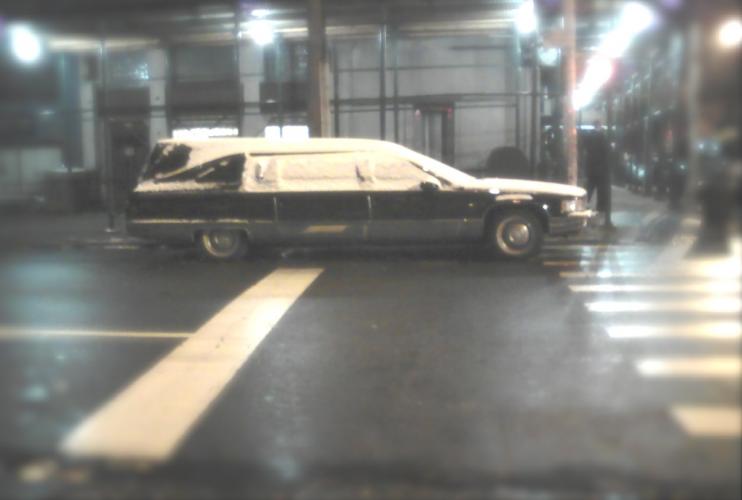
Following that windy memorial, the whole person of Evangelist Rayall Rowan was incinerated in a budget charnelhouse in Queens, and an empty coffin was loaded into a black hearse.
Limbs wobbly with whiskey and skin singed by cold, his friends followed the phantom carriage in a slow, snowy procession uptown.
Your website is activated in Basic membership
$0
Membership - Last-Memories.com
Angel Membership
Monthly Payment as BASIC plus:100 MB disk space
in memory of donation
falling objects
no advertisement
and more... BUY NOW: $4.90